The Monad and the Incarnate Human
Beneath profession, personality, and memory lies something older — the Monad, the indivisible spark of being, experiencing reality through the architecture of the body.
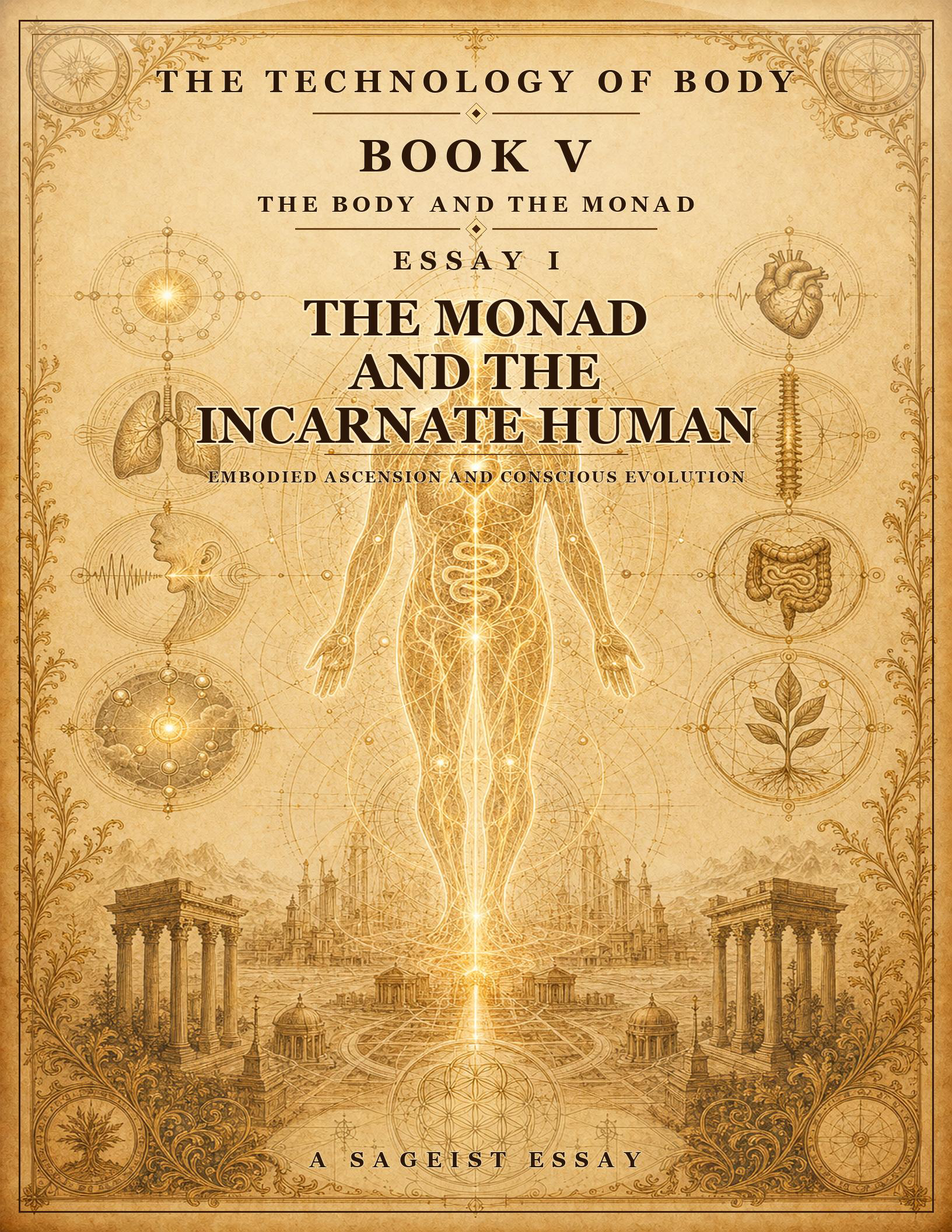
Human beings often ask a fundamental question. Who am I? The question appears simple, yet it opens into one of the oldest chambers of philosophy. A person may answer with a name, profession, nationality, memory, temperament, wound, achievement, family role, spiritual belief, or psychological pattern. Modern culture usually answers through identity because identity is visible, narratable, measurable, and socially legible. It gives the self a costume through which it can move in the world.
Yet beneath every constructed identity lies something older. Something prior to personality itself. Something not exhausted by history, preference, trauma, social category, or memory. Ancient philosophical traditions referred to this essence as the Monad: the indivisible center of consciousness, the irreducible spark of being, that aspect of existence which remains prior to role, memory, and social identity. The Monad is not the personality. It is the one to whom personality appears.
The Monad is not the body. Yet it experiences existence through the body. The Monad is not thought. Yet thought becomes one of its instruments. The Monad is not emotion. Yet emotion becomes one of its languages. The Monad is not biography. Yet biography becomes one of the terrains through which it learns. This distinction does not divide spirit from flesh. It restores hierarchy. The body is not the source of the Monad, but the body becomes the architecture through which the Monad encounters incarnation.
The body therefore becomes more than biology. It becomes the vessel through which consciousness enters material existence. Every sensation, relationship, wound, triumph, loss, desire, fear, pleasure, grief, act of creation, and moment of awakening passes through the body because the Monad experiences reality through embodiment. To be human is not merely to possess consciousness. It is to have consciousness filtered through flesh, time, memory, gravity, lineage, limitation, and relationship.
This relationship changes how we understand embodiment. The body is not accidental matter. It is not disposable machinery. It is not an obstacle placed between spirit and freedom. It is the architecture through which individual consciousness experiences incarnation. Without the body, human consciousness would not taste sweetness, feel warmth, tremble with fear, learn trust through touch, carry grief in the chest, or translate love into action. The body gives consciousness consequence.
Modern culture often treats identity as the final answer to the self. It asks people to define themselves through visible affiliations, psychological descriptions, marketable traits, public positions, and personal histories. These things matter, but they are not ultimate. A person may change profession and remain. A person may lose memory and something remains. A person may heal a wound and something remains. A person may outgrow an old personality and something remains. The question is: what is this remaining?
The doctrine of the Monad does not answer this question cheaply. It does not reduce the human being to a slogan about inner divinity. It asks the reader to notice the difference between the changing and the witnessing. Thoughts change. Emotions change. The body changes. Social roles change. Desires change. Beliefs change. The sense of self changes. Yet awareness knows change. The Monad points toward that indivisible center from which experience is known.
This center is not easily captured by language because language belongs to the world of distinction. Language divides subject from object, name from thing, self from other, past from future. The Monad is not another object inside the person. It is not a glowing stone hidden behind the heart or a small ruler seated in the brain. Such images can be useful symbolically, but they must not be mistaken for literal description. The Monad is a principle of unity beneath the many forms of experience.
Book I revealed the body as technology. Before civilization built its outer systems, the human organism had already organized communication, circulation, defense, rhythm, perception, structure, and adaptation. Book II revealed the nervous system as consciousness interface, the living architecture through which reality becomes experience. Book III revealed symbolic physiology, restoring meaning to the organs, spine, voice, chemistry, and hidden language of the body. Book IV revealed initiation as transformation, the disciplined reorganization of being through breath, ritual, fasting, movement, silence, and attention.
Book V begins a deeper question. Who is the consciousness moving through all these systems? Who breathes through the breath? Who learns through the nervous system? Who reads the symbolic body? Who undergoes initiation? Who remembers beneath memory? Who remains after identities rise and fall? The body is not merely alive. It is inhabited. The Monad is the intelligence dwelling within, not as a possession, but as the center through which the life becomes inwardly meaningful.
To say that the body is inhabited is not to reject science. It is to refuse the reduction of the human being to mechanism alone. A house can be studied through its materials, wiring, proportions, temperature, structure, and function. Yet a house becomes a home when presence enters it. Likewise the body can be studied through anatomy, chemistry, biomechanics, electrical signaling, and cellular intelligence. But the human body becomes a temple when consciousness inhabits it with awareness.
The incarnate human lives between two mysteries. One mystery descends: consciousness entering form. The other mystery ascends: form becoming conscious. The body is the meeting place of both. Spirit does not merely descend into matter and remain trapped. Matter becomes refined through conscious participation. Breath becomes more than respiration. Gesture becomes more than motion. Speech becomes more than sound. Attention becomes more than reaction. The body becomes luminous not because it escapes nature, but because nature becomes transparent to meaning.
The Monad requires incarnation because without limitation, consciousness cannot learn the full dignity of choice. In abstract unity, nothing resists. In the body, everything matters. Hunger matters. Time matters. Mortality matters. Relationship matters. Boundaries matter. Memory matters. Consequence matters. The incarnate condition gives consciousness resistance, and resistance gives development. The body is the school where freedom becomes tested by appetite, fear, pain, desire, duty, love, and death.
This is why the body must not be despised. To despise the body is to despise the very field through which the Monad learns human reality. The body may be wounded, limited, aging, sensitive, fatigued, or imperfect by the standards of image culture. Yet it remains the vessel of incarnation. It is the only place where this life can be lived. Reverence for the body is not vanity. Vanity worships appearance. Reverence honors function, presence, meaning, vulnerability, and sacred participation in existence.
The Monad also changes the meaning of suffering. It does not make suffering good. It does not romanticize trauma or excuse cruelty. Pain remains pain. Loss remains loss. Wounds remain real. But the doctrine refuses to see suffering as meaningless noise alone. Experience presses upon the incarnate human and asks for integration. A wound may become armor or wisdom. A loss may become bitterness or depth. A limitation may become humiliation or humility. The difference depends upon whether consciousness enters the experience.
The body stores what the Monad has not yet integrated. This is why memory is not merely narrative. The organism carries incomplete meanings through posture, breath, tension, impulse, avoidance, and emotional reflex. The Monad does not float above these patterns untouched. It must descend into them through awareness. Healing is not only the removal of symptoms. It is the return of consciousness to places where life was abandoned, defended, frozen, or fragmented.
Identity is therefore both necessary and insufficient. The human being needs identity to function in the world. Names, roles, commitments, histories, relationships, and responsibilities give form to life. But when identity becomes ultimate, the person forgets the deeper center. They become trapped inside performance, wound, ideology, status, or memory. The Sageist does not destroy identity. The Sageist orders identity around the Monad so the outer self serves the inner center rather than replacing it.
This ordering is a form of self-governance. A person ruled by passing states is not yet inwardly ordered. Anger becomes king. Fear becomes king. Desire becomes king. Shame becomes king. Public approval becomes king. The Monad, as indivisible center, does not shout over these forces. It gathers them. It does not eliminate emotion, thought, body, or history. It places them into relationship. The integrated human is not without parts. The integrated human has a center strong enough to hold the parts.
Modern fragmentation can be understood as life without recognized center. The person becomes a sequence of reactions, roles, appetites, opinions, wounds, and performances. Technology intensifies this by offering endless mirrors and interruptions. The self becomes distributed across platforms, obligations, anxieties, and images. Attention is pulled outward until the person forgets the one who is attending. The Monad becomes obscured not by absence, but by noise.
Silence, therefore, becomes one of the ways the incarnate human returns to the Monad. In silence the constructed self begins to loosen its grip. The roles quiet. The public voice fades. The inherited narratives become audible as narratives. The body reveals its state. Beneath this, sometimes only briefly, the person senses a deeper presence that does not depend on performance. This is not escape from embodiment. It is embodiment becoming less crowded by false centers.
Breath also returns the human being to the Monad because breath gathers scattered attention into the living present. Every conscious breath says: I am here. Not as biography alone. Not as role alone. Not as thought alone. As incarnate awareness. The breath does not explain the Monad, but it creates the condition in which the body can be inhabited more fully. The simplest rhythm becomes a doorway into the deepest question.
Movement reveals the Monad through action. A person may discover their center not by thinking about it, but by moving from it. A grounded step, a truthful gesture, a disciplined practice, a bow, a martial form, a dance, a walk in silence - these can reveal whether the body is organized around fragmentation or center. Movement gives the Monad a visible language. The body becomes the calligraphy of consciousness.
Relationship reveals the Monad through encounter. It is easy to imagine oneself unified in solitude. Relationship tests the claim. Another person touches the wound, challenges the image, interrupts the fantasy, calls forth love, patience, jealousy, devotion, fear, tenderness, and truth. The Monad is not realized by fleeing all relation. It must learn to remain present while meeting the other. The incarnate human becomes real through contact.
This is why love is central to embodiment. Love is not merely emotion. It is the recognition that another center of experience exists. To love is to understand, however imperfectly, that one is not the only interior. The Monad recognizes itself as center, but mature consciousness also recognizes other centers. Civilization begins to heal when human beings stop treating one another as objects, functions, threats, or instruments and begin to encounter one another as inhabited beings.
The civilizational implications are immense. A society that forgets the Monad reduces people to categories, labor units, consumers, patients, voters, data points, enemies, markets, or images. It may become efficient, but it loses reverence. A civilization that remembers the Monad designs differently. Education becomes the cultivation of centered humans. Medicine treats bodies without forgetting inhabitants. Economics serves life rather than abstract appetite. Technology respects attention because attention belongs to consciousness. Governance recognizes that true leadership begins with inner order.
The body, in this view, is not a private possession disconnected from civilization. It is the site where civilization begins. If millions of people live without inner center, collective systems will reflect fragmentation. If millions become more coherent, culture can begin to reorganize. The Monad is individual, yet its awakening has collective consequence. Presence spreads through rooms, families, institutions, and societies. The integrated human is the future because only integrated humans can build systems that do not reproduce fragmentation.
The Monad also reframes death. The body is mortal. It changes, ages, weakens, and eventually returns to earth. The personality, too, changes. Memory fades. Roles dissolve. Possessions scatter. Even reputation becomes unstable in time. The question of the Monad asks whether there is a deeper continuity beneath these transformations. This is not a matter for careless certainty. It is a matter for reverent contemplation. Mortality becomes the great teacher of essence because it strips away what cannot remain.
To contemplate death is to ask what is real before the final threshold. What have I served? What have I embodied? What has passed through me into the world? What did my attention worship? What did my body make visible? What did my presence transmit? These questions bring the Monad back into daily life. They reveal that incarnation is not endless time. It is a sacred interval in which consciousness is asked to become responsible.
The Monad also reveals the shadow with greater precision. The shadow is not merely what is bad within the person. It is what has not yet been brought into conscious relationship with the center. A gift can be shadow if it is disowned. Anger can be shadow if it is exiled until it becomes sabotage. Grief can be shadow if it hides beneath control. Power can be shadow if the person refuses to admit the desire to influence reality. The Monad does not destroy these forces. It calls them into order.
Shadow integration is therefore not indulgence. It is governance. The incarnate human must learn to tell the truth about the contents of the psyche without surrendering the throne to them. A person may feel envy without becoming envy. They may feel rage without becoming rage. They may feel fear without allowing fear to design the future. The Monad serves as center because it can witness the part without becoming identical to the part. This is the beginning of inner civilization.
Every civilization has a shadow because every civilization is built by incarnate humans. What a culture refuses to integrate returns through its institutions. Denied grief becomes entertainment soaked in violence. Denied fear becomes surveillance and control. Denied appetite becomes extraction. Denied loneliness becomes markets of distraction. Denied spiritual hunger becomes ideology. A society without a center externalizes its disowned forces until the public world becomes a theater of collective shadow.
The doctrine of the Monad therefore has political, educational, and architectural consequence. A school should not merely manufacture skilled personalities. It should help the young remember that they are more than performance, comparison, and achievement. A political order should not merely manage competing appetites. It should cultivate conditions in which human beings can mature into responsibility. Architecture should not merely shelter functions. It should help the inhabitant remember dignity, silence, beauty, orientation, and depth.
The incarnate human also requires ritual forms that reinforce the center. Not rituals of domination, conformity, or spectacle, but practices that return the person to inward order. A morning breath before the world enters. A meal received with gratitude. A period of silence before speech. A walk that restores relation to earth. A confession that returns language to truth. A vow that aligns conduct with essence. These are not minor gestures. They are ways of teaching the body that the Monad must be remembered through life.
There is a danger in speaking of the Monad as though it were separate from ethical action. A person can use metaphysics to avoid repair. They can claim inner divinity while refusing apology. They can speak of unity while exploiting others. They can invoke consciousness while remaining careless with the body, the home, the community, and the earth. The Sageist refuses this split. If the Monad is real, it must become more truthful in speech, more reverent in touch, more disciplined in appetite, and more responsible in power.
Incarnation means that the invisible must become visible. The inner center must become a way of walking, listening, building, choosing, eating, working, loving, and dying. The Monad is not honored by escape from ordinary life. It is honored when ordinary life becomes transparent to consciousness. The kitchen, desk, street, council room, classroom, sickbed, studio, and altar all become fields where the incarnate human either remembers or forgets.
The Monad does not make the human being superior to nature. It makes the human being accountable within nature. The body belongs to earth. It is made of minerals, water, breath, fire, ancestry, and food. It participates in ecosystems, climates, rhythms, and decay. The Monad does not hover above this ecology as a foreign ruler. It awakens inside it. The incarnate human is cosmic and earthly at once. This is the humility of embodiment.
Sophia is hidden here as the intelligence of relationship between center and world. The Monad without Sophia can become abstraction, a cold principle of unity detached from tenderness. Sophia gives the doctrine beauty, receptivity, emotional intelligence, and reverence for the living field. She teaches that the center does not exist to dominate the parts, but to harmonize them. The soul becomes wise when unity learns how to love multiplicity.
The warrior principle is also required, because the Monad must be protected from false identification. The world will ask the human being to become only a role, only a wound, only a brand, only a reaction, only a function. The initiate must refuse. This refusal is not arrogance. It is guardianship. A person must protect the inner center from capture, not by withdrawing from life, but by entering life without forgetting who is entering.
The incarnate human lives as a bridge. Below: instinct, ancestry, earth, hunger, survival, body. Above: meaning, purpose, consciousness, unity, Monad. The task is not to abandon the lower for the higher or collapse the higher into the lower. The task is integration. The feet must remain on earth while the crown remembers height. The heart must mediate between survival and transcendence. The body becomes the bridge on which the human being learns wholeness.
This wholeness cannot be rushed. It is not achieved through a single insight, a dramatic ceremony, or a declaration of spiritual identity. It is built through repeated return to center. When fear rises, return. When desire pulls, return. When grief opens, return. When praise inflates, return. When shame contracts, return. When technology scatters attention, return. The Monad is remembered through fidelity to the center across changing states.
The danger is to speak of the Monad while remaining disembodied. A person can use high metaphysics to avoid ordinary responsibility. They can claim unity while refusing accountability, speak of consciousness while ignoring the body, speak of transcendence while harming relationships, speak of spiritual essence while neglecting the conditions of life. This is not Sageism. The doctrine insists that the highest truth must become visible in embodied conduct.
The incarnate human is therefore judged not by mystical language alone, but by coherence. Does the person become more truthful? More present? More disciplined? More compassionate? More capable of complexity? More responsible with power? More reverent toward life? More able to build rather than merely critique? The Monad is not proven by speech. It is revealed by the quality of embodiment.
Book V begins here because the journey has moved from architecture to inhabitant. The body has been examined as technology, interface, symbol, and initiatory field. Now the doctrine turns toward the one who lives through it. The human being is not a random assembly of systems. Nor is the human being a ghost accidentally trapped in flesh. The human being is incarnate consciousness: a Monad entering the world through body, history, relationship, and time.
Essay I opens the gate of Book V with this recognition: the body is inhabited. To remember the Monad is to remember the center beneath identity. To honor the body is to honor the vessel of incarnation. To integrate the two is to begin the path of embodied ascension, not as escape from life, but as a deeper participation in it.
The gate closes here: the Monad is the indivisible center, and the body is the living temple through which that center experiences the world. The self is more than role, memory, wound, or desire. The body is more than matter. Human life is the meeting of both. The incarnate human becomes whole when consciousness remembers its center and the body becomes faithful to that remembrance.